Atatürk’s House in Trabzon: A Nation’s Memory Between Walls and Trees
I left Batumi early in the morning, heading toward the Georgian-Turkish border—barely twenty kilometers away. On the Turkish side, a car was waiting for me, arranged thoughtfully by my brother and lifelong friend, Dr. Nasser Al-Mansouri, who spends his summers in the beautiful coastal city of Trabzon, nestled along the Black Sea and crowned by lush green hills.
The drive from the border to Trabzon stretched for 180 kilometers along a scenic highway. The sea accompanied us from the west, and the emerald mountains rose gracefully on the eastern side, dotted with cascading waterfalls and sleepy villages that whispered forgotten stories.
Dr. Nasser, an urban planning and road design expert who worked with me in the United Arab Emirates in the 1990s, knows my passion for urban history and memory-laden places well. On the way, he suggested we stop briefly in Erzincan to visit another house associated with Mustafa Kemal Atatürk—a detour I gratefully accepted.
A Brief Stop, Etched in Memory
In a quiet neighborhood in Erzincan, on a gentle hillside just off the highway, stood Atatürk’s modest house—humble from the outside but rich in symbolism. The two-story structure, built of stone and wood, was painted in soft white, its expansive windows opening onto the surrounding fields.
Inside, the house offered a sense of stepping into another era. The rooms were simple yet dignified, retaining original furnishings and rare photographs of Atatürk during his visits to Eastern Anatolia. In one corner, Ottoman books were carefully stacked beside an aged map of the Turkish Republic. An old wooden desk and a vintage typewriter hinted at the thoughtful presence of a leader drafting visions for a new nation.
Though the visit was brief, it left a deep impression. Even in a modest home like this, Atatürk’s legacy lingered in every corner and object.
On to Trabzon… Where Memory Finds Form
By evening, I arrived in Trabzon and made my way to Atatürk’s Pavilion (Atatürk Köşkü), perched on a verdant hill in the Boztepe district. The mansion overlooks the Black Sea, standing guard over a city that has witnessed profound transformations throughout the 20th century.
Built in 1890 by Konstantin Kabayanidis, an Ottoman subject of Greek or Armenian descent, the house was originally a summer retreat for his family. But history is merciless with permanence. In 1923, following the Treaty of Lausanne, Turkey and Greece undertook a massive population exchange, displacing hundreds of thousands of Orthodox Christians from Turkish lands and replacing them with Muslims from Greece. Thus, the mansion passed into state hands—its private story absorbed into the larger narrative of a reshaped nation.
Atatürk first visited the house on September 15, 1924, less than a year after founding the Republic. He saw in it a vision of the Turkey he wished to build: modern, rooted, balanced. On a return visit in 1930, he made a deeply symbolic gesture—donating all his personal property to the Turkish people.
After his death, the house was inherited by his sister, Makbule Hanım, until April 6, 1943, when the municipality of Trabzon acquired and restored it, transforming it into a museum bearing his name. Since then, it has welcomed all who seek to walk through history, not merely read it.
When Stones Speak
A sense of reverence wraps around you when you enter the mansion. The walls are adorned with delicate classical motifs. Crystal chandeliers hang from lofty ceilings—the hardwood floors gleam, softened by handwoven carpets echoing a bygone Ottoman elegance.
The rooms are carefully arranged, and many are still furnished with period pieces: marble-top tables, carved wooden chairs, gilded mirrors, and ticking wall clocks that seem to defy time. In a quiet corner, a desk believed to have belonged to Atatürk remains silent yet eloquent.
The house spans three floors, each telling its own story. The upper level contains Atatürk’s private bedroom—modest and serene. No lavish display, just a space for contemplation and quiet leadership.
And as I left the house, I whispered to myself:
How noble are the nations that preserve the homes of their leaders—not to glorify individuals, but to honor an idea, and to respect an era that shaped what followed.
Future generations are not required to agree with their historical figures, but they are duty-bound to protect the memory of those figures from erasure, simplification, or distortion.
For in every old house, behind every table, hallway, and clock, there is something deeper than wood and stone—there is the story of a nation.
Nations that erase the traces of their leaders with every shift in opinion, unknowingly erase fragments of their own identity.
Leaders pass away, but the homes they lived in continue to ask us:
Did you preserve what was? And did you understand why it was?
The Statue of Ilia Chavchavadze in Batumi: On Symbols That Endure… and Others That Are Erased
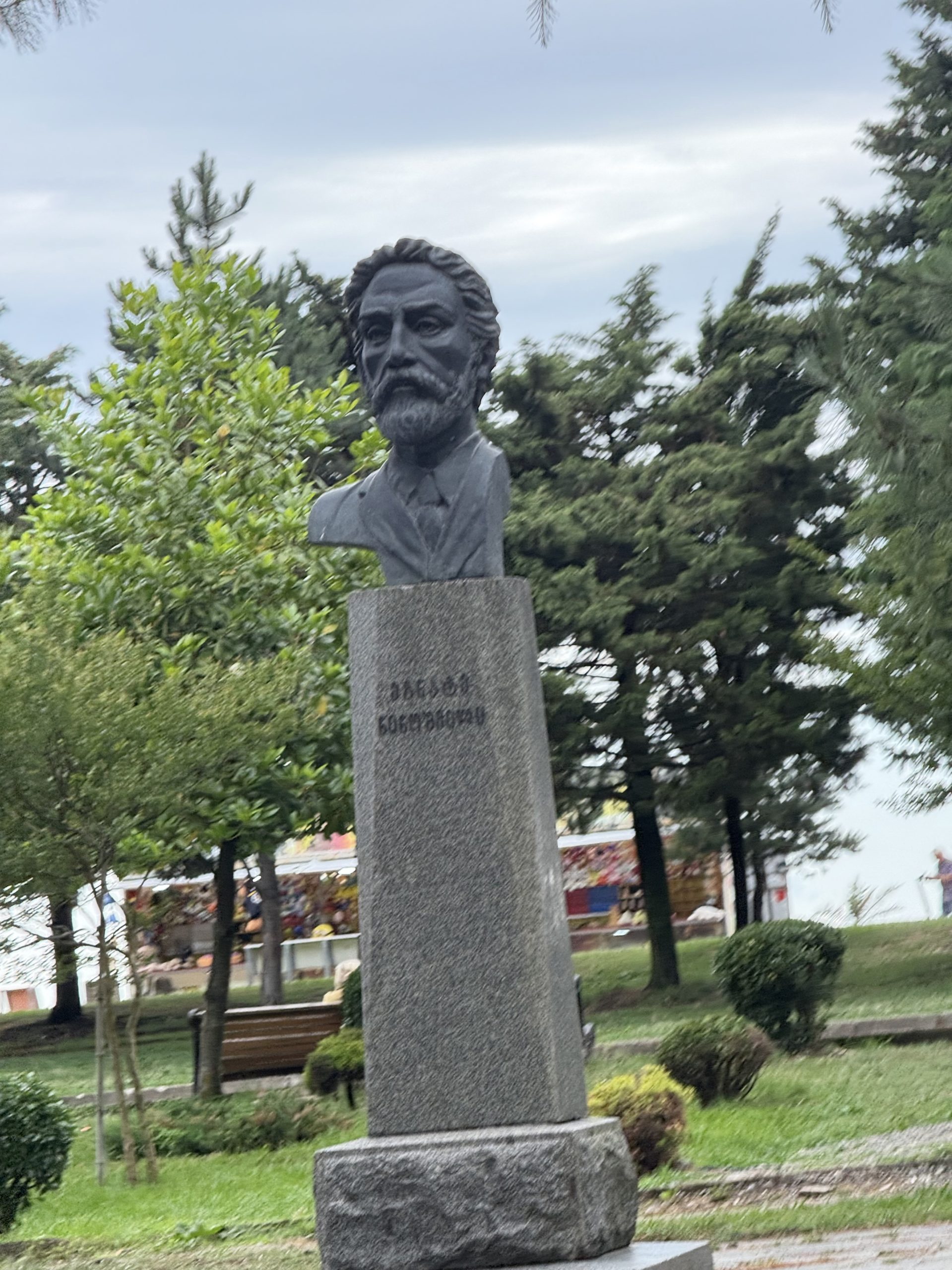
During my recent visit to the coastal Georgian city of Batumi, I paused in reflection before a bronze bust of a figure whose features were unfamiliar to me, yet whose presence commanded respect. I stepped closer to read the inscription: Ilia Chavchavadze.
One of Georgia’s great national revivalists stood, a poet, thinker, and reformer of the 19th century who championed the Georgian language, identity, and sovereignty under Russian rule.
But this was not just a moment of cultural discovery — it became a moment of questioning:
How do civilized nations preserve their memory? And how do living nations honor their symbols?
In countries where democracy and pluralism prevail — such as modern Georgia — cultural figures are celebrated and immortalized in public spaces, educational institutions, and even on currency. These nations respect their past not by rewriting it, but by building upon it, layer by layer.
In contrast, many developing nations suffer from a chronic illness: their collective memory is hostage to political power. Statues are toppled, street names erased, and entire cities renamed at the whim of whoever holds the reins of authority, as though history must be rewritten with each new regime.
Baghdad as a Stark Example:
In Baghdad, the city of civilizations, the pattern is clear — public names and symbols change with every political shift:
• Al-Rasheed Street, once Baghdad’s cultural and commercial artery, now stands in neglect, stripped of its former glory.
• The King Faisal II Bridge, inaugurated in 1957, was renamed 14th of July Bridge after the 1958 revolution, and later became known as the Republic Bridge, reflecting not a narrative of continuity, but one of repeated rupture.
• The City of Al-Thawra (Revolution City) became Saddam City, then was renamed again as Sadr City, erasing and rewriting identity with every ruling regime.
• The statue of Caliph Abu Jaafar Al-Mansur, founder of Baghdad, was targeted multiple times after 2003, removed under sectarian or ideological pretexts, then reinstalled under public pressure — as if even stone must submit to political negotiation.
Such treatment of public memory does not reflect critical reflection or cultural dynamism — it reflects a profound identity crisis and the absence of a mature state ethos.
Standing before Chavchavadze’s statue in Batumi was not merely a touristic pause, but a moment of meditation on the value of symbolic continuity, cultural reverence, and honoring those who serve society through intellect and words, not swords and slogans.
Will Baghdad ever honor its true minds — from Al-Jahiz and Al-Mutanabbi to Ali Al-Wardi and Muhammad Mahdi Al-Jawahiri — with monuments that transcend political fashion?
“A closed mind does not build a nation: A call for openness for a new Iraq”
Dear friends,
We are the sons of a diverse country, rich in cultures, components, religions, and dialects. Unfortunately, this richness has often become a source of division rather than a source of strength in our distant and recent history. We disagree, then quarrel; we engage in dialogue, then attack; and reject others simply because they are “different.”
In such circumstances, as Iraq is currently experiencing a period of calm that will inevitably continue with the wisdom of the wise, it is worth rereading what the late Iraqi thinker Ali al-Wardi said in his book The Farce of the Human Mind:
“He who never departs from the environment in which he was born, who reads only books that reinforce his inherited beliefs, and who focuses solely on the culture of his homeland, cannot be neutral in his judgment. Rather, he is expected to be imbued with a fierce nationalism and a firm intellectual steadfastness.”
These words are not directed against our adherence to our convictions, but against stagnation, against closing our minds and living in an “intellectual bubble” from which we see nothing.
Our diversity is not a curse but an opportunity. From Kurds and Turkmen to Arabs, Shiites to Sunnis, Christians to Yazidis and Mandaeans, Iraq is a multifaceted entity. Coexistence can only succeed when we learn to see the world differently.
Isolation breeds intolerance. When we read only what affirms our ideas, befriend only those who resemble us, and reject those who disagree, we become “solid walls,” shutting out the light. Our country, Iraq, has paid a heavy price for this intolerance in the past.
Iraqi youth are the true linchpins of change. The post-2003 generation didn’t create the past, but they hold the keys to the future. And the key to the future is openness to others—not as a threat but as an opportunity for understanding and perhaps for correction.
How do we reshape our consciousness? Learning about and reading about those who differ from us in thought is essential: Don’t just accept what satisfies your convictions; read what contradicts them. We must engage in respectful dialogue, not ridicule those who differ, and accept that the truth is not absolute. We are all on a continuous journey of discovery. We must believe that a new Iraq begins with the minds of young people. We cannot build a new Iraq with old minds, and we cannot create internal peace if we do not learn to respect other opinions.
Openness is not weakness but strength. Doubting our heritage is not blasphemy but the beginning of awareness.
Let us emerge from our intellectual walls and build a homeland that excludes no one.
Finally, let us free ourselves from the rigidity of our judgments and allow our minds and hearts to see others with new eyes that care about the unity of Iraq and its people.
The Babylonian World Map

The British Museum in London houses an extraordinary collection of artifacts from Mesopotamian civilization—one of the oldest in human history.
Among its most notable exhibits are:
-
The Cyrus Cylinder, considered one of the earliest legal texts in the world.
-
The winged bulls (Lamassu) that once guarded the entrances of Assyrian palaces and temples in Nimrud and Ashur.
-
Wall panels from the Ishtar Gate, decorated with divine symbols and mythical animals.
The museum’s collection also includes a vast number of cuneiform tablets, inscribed with a variety of texts such as letters, contracts, religious hymns, and literary masterpieces like the Epic of Gilgamesh. Other highlights include the statue of King Ashurbanipal II, artworks reflecting everyday life in Mesopotamia, ritual objects, and the renowned Wounded Lioness sculpture, which I discussed in a previous article.
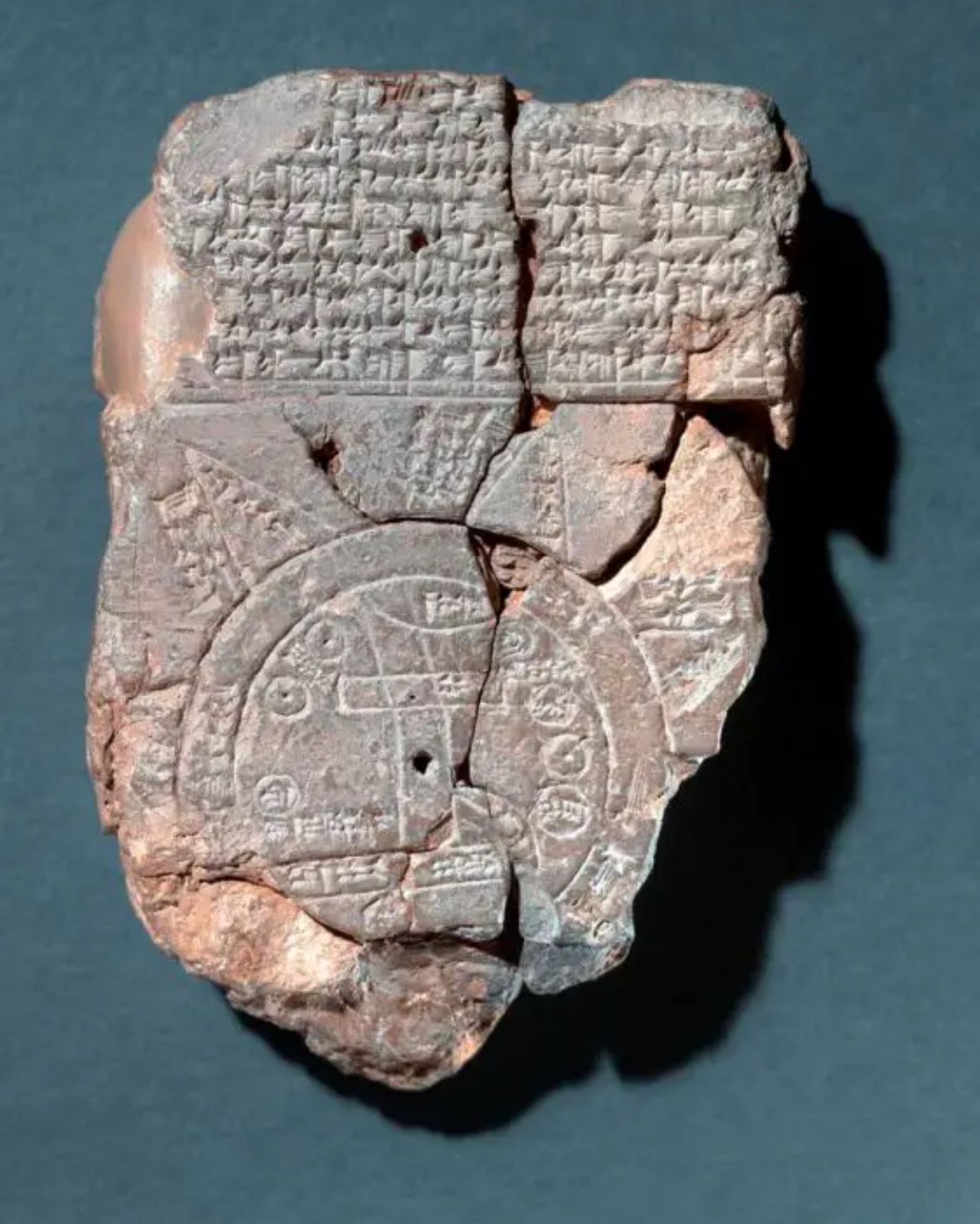
In this article, I focus on one of the most important and fascinating exhibits in the museum:The Babylonian World Map, known as Imago Mundi, dating back to the 6th century BCE.
Discovered in 1889 by a British expedition in the ancient Babylonian city of Sippar, this map is carved on a small clay tablet.
What the Map Shows:
This ancient map portrays the world as imagined by the Babylonians. At the center is Babylon, reflecting their belief that it was the heart of the universe. Surrounding Babylon are other cities like Susa and Ur, while natural features such as marshes and mountains are shown as circles or rectangles.
The Euphrates River is clearly depicted, and the entire known world is enclosed by a circular body of water—referred to as the “Great Ocean.”
Beyond this ocean, the map reveals mysterious outer regions referred to as “the other lands.” These areas are believed to represent mythical territories and are described in the cuneiform inscriptions, often linked to legends, rituals, and cosmological beliefs.
Historical and Cultural Significance:
This map is a testament to the Babylonians’ advanced understanding of geography and their desire to make sense of the world. It merges mythology and reality, illustrating their spiritual and intellectual view of the universe.
The artifact likely dates back to the reign of King Nebuchadnezzar II, during a time when Babylon was a thriving empire stretching from the Persian Gulf to the Mediterranean Sea. The map emphasizes Babylon’s central role in their worldview, both politically and cosmologically.
Today, this remarkable object offers not only historical value but also insight into how ancient civilizations perceived their place in the world—where mythology, geography, and power coexisted on a single clay tablet.
The Wounded Lioness

Whenever I visit a new country, I make it a priority to explore its national museums. Among the world’s most important institutions that house a vast collection of ancient Iraqi artifacts are the British Museum in London and the Louvre Museum in Paris. Both have dedicated galleries showcasing the heritage of the Middle East across different eras, right up to the present day.
During my recent visit to London, I was particularly keen to see one of the most iconic works in the British Museum: The Wounded Lioness sculpture. This piece is part of a large relief panel measuring 40.6 meters in length and 1.6 meters in height. It dates back to the Neo-Assyrian period (668–631 BCE) and originally adorned the grand Throne Room of King Ashurbanipal’s palace in Nineveh.
The reliefs from the Throne Room are architectural masterpieces that express royal power and prestige. King Ashurbanipal’s palace is considered one of the crowning achievements of Assyrian architecture in ancient Nineveh.
The walls of the hall are covered in intricately carved stone panels filled with stunning detail, placing the king at the center—ruling and leading his people through military campaigns. These reliefs are among the greatest artistic achievements of the Assyrian era, brilliantly blending technical finesse with political and religious symbolism. They served as a medium to project the king’s divine strength and authority.
The Assyrian artist depicted religious scenes, war campaigns, and hunting rituals, especially the royal lion hunts—considered essential ceremonial acts for Assyrian kings, symbolizing their divine authority. The lion, in ancient times, represented both destruction and protective power. The king’s victory over the lion in these scenes conveyed his strength as a ruler chosen by the gods.
While most of the animals portrayed in these scenes are lions, adding dramatic power to the composition, the variety of expressive poses and vivid detail elevate the reliefs artistically. Blood can be seen pouring from the lions’ mouths, struck by the king’s poisoned arrows.
Among these depictions, The Wounded Lioness stands out. It is the only representation of a female lion in the entire scene, and it is considered one of the most emotionally powerful and masterfully crafted artworks of the ancient world. Found among the reliefs decorating Ashurbanipal’s palace—including the grand throne room—this sculpture highlights the exceptional skill of the Assyrian sculptors.
The lioness is shown in the final moments of life, struck by arrows during the royal hunt. The sculptor rendered her physical details with remarkable precision: tense muscles, claws digging into the ground, a twisted tail recoiling in agony, arrows embedded in her body, and visible traces of blood. These elements portray the harrowing battle between life and death. Even as she collapses, the lioness strives to rise, embodying a raw, unyielding will to survive. Her carved eyes reflect pain, sorrow, and perhaps defiance—an extraordinary achievement in ancient sculpture.
The lioness, wounded by a skilled hunter’s arrows, still emanates strength. Her anguished eyes, bloodied body, and desperate motion convey the message: wounds may limit movement, but they do not extinguish resistance.
The relief is carved in limestone and displays astonishing craftsmanship in its fine details—from the lioness’s fangs and muscular lines to the blood flowing from her body—making the scene startlingly lifelike. Today, The Wounded Lioness is among the most celebrated Assyrian artworks in the British Museum, captivating visitors with its realism and emotional intensity.
Discovered during 19th-century excavations in Nineveh, this masterpiece was transported to the British Museum, where it remains a highlight of the collection—drawing admiration from both scholars and museumgoers for its artistic brilliance and historical significance.
Enheduanna – The First Known Poet and Writer in History
Enheduanna is a prominent historical figure, regarded as the first known poet and writer in human history. Her writings carry deep religious and personal themes. She lived during the reign of King Sargon of Akkad (circa 2334–2279 BCE), the founder of the Akkadian Empire in Mesopotamia.
In 1927, a joint excavation team from the British Museum and the University of Pennsylvania discovered the ruins of the Royal Cemetery in the ancient city of Ur, which contained many royal tombs and precious treasures dating back to the mid-third millennium BCE.
Among the findings were over 5,000 ancient Mesopotamian literary tablets. One of the most remarkable discoveries was a small round alabaster disc depicting the high priestess Enheduanna, daughter of King Sargon of Akkad. She is shown wearing a long robe and a headdress, with braided hair cascading over her shoulders. The disc shows her holding a scepter and leading a religious ritual in front of a deity’s altar, offering prayers and sacred rites.
Harvard art historian Irene J. Winter described the disc as being carved from semi-translucent alabaster, with a diameter of approximately 25.6 cm and a thickness of 7.1 cm..

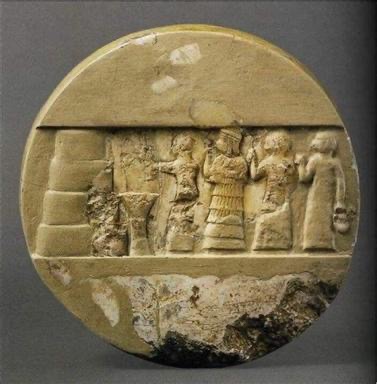
The disc features Enheduanna approaching the altar to offer a sacrifice, and the inscription reads:
“Enheduanna, wife of the god Nanna, daughter of Sargon, king of the world, for the temple of the goddess Inanna, made this seal in dedication to the god Anu.”
Alongside the disc, other objects bearing her name were found, including seals and clay tablets. The disc is currently housed in the Penn Museum of Archaeology and Anthropology in the United States.
Among the tablets discovered was one containing preserved lines from a long poem in which she wrote:
“I am Enheduanna… I have taken my place in the temple dwelling. I am the high priestess.”
These words are considered among the earliest known examples of autobiographical writing and self-authored literary work.
Before this discovery, Enheduanna was unknown to modern scholars, but the finding of the disc and clay tablets significantly expanded our understanding of ancient Iraqi history.
In global literature, Enheduanna is recognized as the first recorded female author, credited with the earliest known written poetry. She was the first woman to sign her name to her literary work—at a time when most texts were anonymous.
William W. Hallo, an Assyriologist at Yale University, described her as the “Shakespeare of Sumerian literature.” She preceded the Epic of Gilgamesh by 800 years, and the Greek poet Homer—author of the Iliad and Odyssey—by 1,100 years. She also lived around 1,700 years before the Greek poetess Sappho.
Enheduanna combined her status as a princess, her religious role as high priestess, and her brilliance as a poet, making her a truly exceptional figure in the history of ancient Iraq. Her writings have inspired countless scholars and writers worldwide, and her works have been translated into English and German.
Roberta Binkley, professor of English literature at the University of Tennessee, described her as “the bold, strong voice women need to hear.”
In recognition of her literary and intellectual contributions, the International Astronomical Union named a crater on the surface of Mercury “Enheduanna” in 2015—selected from over 3,500 proposed names.
The Poem “Exaltation of Inanna”
Among Enheduanna’s most famous works is the poem Exaltation of Inanna, which consists of 153 lines. The poem is a hymn of praise to the goddess Inanna, the Sumerian deity of love and war.
This piece is considered one of the earliest preserved literary compositions. It was written in Sumerian on clay tablets using cuneiform script. One of its lines reads:
“Lady of all divine powers, radiant light, glorious woman, jewel of heaven and earth, priestess of the highest god.”
Enheduanna was not just a writer or poet—she was an intellectual pioneer and a proto-feminist voice striving to erase the lines of gender inequality. She left an indelible mark on human history and gave voice to women in a time when writing was dominated by men.
As an Iraqi descended from this generous land, I am proud that a woman from the land of my ancestors had her name chosen for a crater on the planet Mercury—selected by the International Astronomical Union in 2015, from among 3,500 proposed names.
Sarah’s story

In the early 20th century, an exceptional woman named Sara Ohannes Hovhannes emerged as a prominent figure in Iraqi history. Born in Baghdad in 1889 to an Armenian family, Sara experienced early tragedy with the loss of her mother, Sophie, and her younger sister, Zabel. After their deaths, her aunt, Sophie, took care of her and inherited a large fortune from her father, which included money and land in Baghdad and a prosperous area that would later become known as “Camp Sara.”
Sarah grew up in a beautiful house on Rashid Street overlooking the Tigris River. In memory of her sister Zabel, who died at the age of six, her father donated one of the family’s large homes to the Armenian community in Baghdad, which they converted into a school called the Zabelian School.
A pivotal event in Sarah’s life occurred in August 1910, when Nazim Pasha, the Ottoman governor of Baghdad, organized a lavish boat dance to raise funds for a new hospital. The event, which included diplomatic figures, representatives of foreign communities, and local Christian families, became the talk of the town. Sarah attended with her family, dressed in traditional Armenian garb, and despite her young age—just 17—she caught the attention of Nazim Pasha, who was then fifty years old. When he asked for her hand in marriage, she refused, angering the governor, who felt deeply offended.
What followed was dramatic. Nazim Pasha used his power to pursue Sara doggedly, ignoring her outright refusal. These tensions escalated amid growing political unrest in Baghdad, where various factions were vying for influence. Amid this turmoil, journalist Ismail Hakki Baban—associated with the Union and Progress Party—visited Baghdad and discovered what had happened to Sara. He wrote scandalous articles criticizing the governor’s actions, sparking a wider wave of popular anger.
In early 1911, Iraqi representatives in the Ottoman Assembly filed a formal complaint against Nazim Pasha’s conduct, prompting intervention from Istanbul. Following intense popular and political pressure, he was removed from office on March 17, 1911.
But Sarah’s role was not limited to politics; she also made significant humanitarian contributions. In 1915, as the Armenians’ suffering intensified during the genocide, she founded the Armenian Women’s Association to aid the displaced and afflicted. By 1917, she had provided food and clothing to some 20,000 Armenian refugees in Iraq, embodying her profound commitment to those most in need in times of crisis.